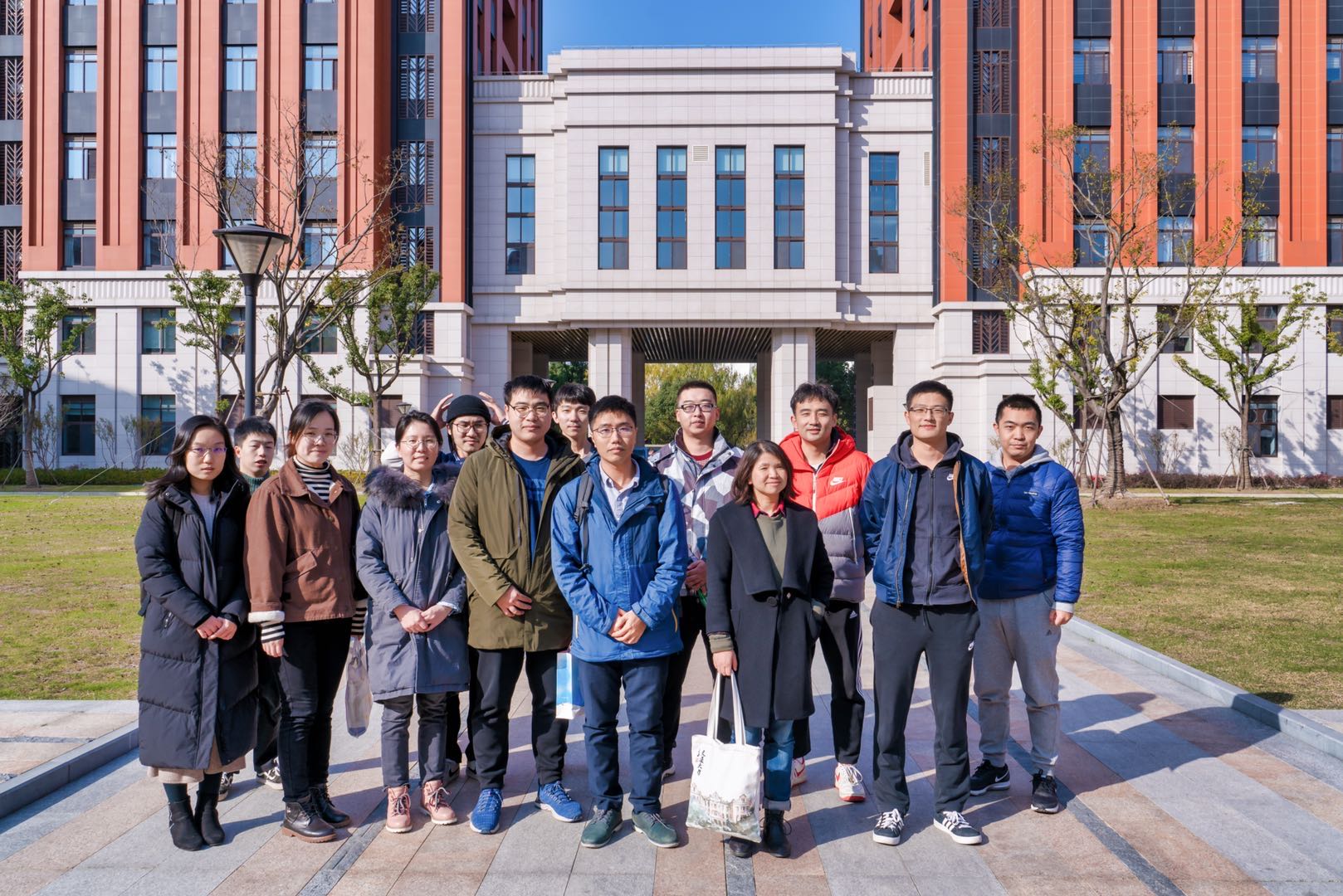
About LIMO
The Lab for Imaging, Machine Learning and Optimization (LIMO) brings together researchers in mathematics and computer science at Shanghai Jiao Tong University. We combine mathematical modeling, optimization, and machine learning to solve inverse and data-driven problems, with close connections to scientific, experimental, and clinical applications.
Research areas
Explore our researchInverse Problems and Computational Imaging
We develop mathematical models and reliable algorithms for recovering information from incomplete, noisy, or indirect measurements.
Learn moreMedical Imaging
We build reconstruction, correction, and analysis methods that connect mathematical insight with clinically relevant imaging problems.
Learn moreOptimization and Machine Learning
We study the algorithms and mathematical structures that make large-scale learning and data-driven computation efficient and dependable.
Learn moreFeatured work
View featured publications- Conference
A Memory-Efficient Hierarchical Algorithm for Large-Scale Optimal Transport Problems
In The Fourteenth International Conference on Learning Representations (ICLR), 2026We propose HALO, a memory-efficient hierarchical algorithm for solving large-scale optimal transport (OT) problems with squared Euclidean cost, particularly effective in moderate-dimensional settings. The core of HALO lies in combining a hierarchical representation of the OT problem with parallel-friendly linear programming solvers, within which an active pruning technique is integrated to further reduce memory usage and computational cost. Theoretically, we establish a scale-independent iteration-complexity upper bound for the refinement phase, which is consistent with our numerical observations. Numerically, experiments on the image dataset and the 3D point cloud dataset demonstrate that HALO effectively alleviates the memory and scalability bottlenecks of existing solvers. Our method demonstrates significant advantages compared to state-of-the-art baselines: for images with n=1024^2 pixels, it achieves an 8.9\times speedup and 70.5% reduction in memory usage under comparable accuracy; for 3D point clouds at scale n=2^18, it achieves a 1.84\times speedup and an 83.2% reduction in memory usage with 24.9% lower transport cost.
@inproceedings{xia2026memory, title = {A Memory-Efficient Hierarchical Algorithm for Large-Scale Optimal Transport Problems}, author = {Xia, Wenzhou and Zhu, Ya-Nan and Liang, Jingwei and Zhang, Xiaoqun}, booktitle = {The Fourteenth International Conference on Learning Representations (ICLR)}, year = {2026}, } - Journal
Limiting Over-Smoothing and Over-Squashing of Graph Message Passing by Deep Scattering Transforms
Journal of Machine Learning Research, 2026Graph neural networks (GNNs) have become pivotal tools for processing graph-structured data, leveraging the message passing scheme as their core mechanism. However, traditional GNNs often grapple with issues such as instability, over-smoothing, and over-squashing, which can degrade performance and create a trade-off dilemma. In this paper, we introduce a discriminatively trained, multi-layer Deep Scattering Message Passing (DSMP) neural network designed to overcome these challenges. By harnessing spectral transformation, the DSMP model aggregates neighboring nodes with global information, thereby enhancing the precision and accuracy of graph signal processing. We provide theoretical proofs demonstrating the DSMP’s effectiveness in mitigating these issues under specific conditions. Additionally, we support our claims with empirical evidence and thorough frequency analysis, showcasing the DSMP’s superior ability to address instability, over-smoothing, and over-squashing.
@article{jiang2026limiting, title = {Limiting Over-Smoothing and Over-Squashing of Graph Message Passing by Deep Scattering Transforms}, author = {Jiang, Yuanhong and Zou, Dongmian and Zhang, Xiaoqun and Wang, Yu Guang}, journal = {Journal of Machine Learning Research}, year = {2026}, volume = {27}, number = {77}, pages = {1--39}, } - Journal
A Guide to Stochastic Optimisation for Large-Scale Inverse Problems
Inverse Problems, 2025Stochastic optimisation algorithms are the de facto standard for machine learning with large amounts of data. Handling only a subset of available data in each optimisation step dramatically reduces the per-iteration computational costs, while still ensuring significant progress towards the solution. Driven by the need to solve large-scale optimisation problems as efficiently as possible, the last decade has witnessed an explosion of research in this area. Leveraging the parallels between machine learning and inverse problems has allowed harnessing the power of this research wave for solving inverse problems. In this survey, we provide a comprehensive account of the state-of-the-art in stochastic optimisation from the viewpoint of variational regularisation for inverse problems where the solution is modelled as minimising an objective function. We present algorithms with diverse modalities of problem randomisation and discuss the roles of variance reduction, acceleration, higher-order methods, and other algorithmic modifications, and compare theoretical results with practical behaviour. We focus on the potential and the challenges for stochastic optimisation that are unique to variational regularisation for inverse imaging problems and are not commonly encountered in machine learning. We conclude the survey with illustrative examples from imaging on linear inverse problems to examine the advantages and disadvantages that this new generation of algorithms bring to the field of inverse problems.
@article{ehrhardt2024guide,
  title = {A Guide to Stochastic Optimisation for Large-Scale Inverse Problems},
  author = {Ehrhardt, Matthias J. and Kereta, Zeljko and Liang, Jingwei and Tang, Junqi},
  journal = {Inverse Problems},
  volume = {41},
  number = {5},
  pages = {053001},
  year = {2025},
  publisher = {IOP Publishing},
}
Latest news
All news- A new preprint “VeriScale: Adversarial Test-Suite Scaling for Verifiable Code Generation” is now online.
- Our paper “Exploring the Feasibility of Self-Supervised Learning for X-Ray Bone Image Analysis” has been published in Applied Mathematics for Modern Challenges.
- A new preprint “Formalization of Two Fixed-Point Algorithms in Hilbert Spaces” is now online.
- Our paper “Enhancing Medical Imaging Out-Of-Distribution Detection with Synthetic Outliers” has been published in Journal of Mathematical Imaging and Vision.
- A new preprint “Adaptive Dimension Reduction for Overlapping Group Sparsity” is now online.
More recent work
All publications- Preprint
Mixed-Noise Plug-and-Play with Infimal Convolution Fidelities and Multiple Priors
arXiv preprint arXiv:2609.33897, Sep 2026Plug-and-Play (PnP) algorithms are a class of iterative methods for inverse imaging. Within an optimization algorithm, they combine a flexible fidelity term, encoding the forward operator, and a pretrained image denoiser, in order to deal with more severe corruptions such as blurring or downsampling when reconstructing an image. This work studies provably convergent PnP methods for mixed-noise forward processes by using the infimal convolution as a fidelity term, providing a statistical interpretation as a joint maximum a-posteriori estimator over both noises, and preserving the Bayesian MAP interpretation of PnP methods. Independently, we extend the PnP formulation to multiple prior terms using the Davis–Yin three-operator splitting. This extension can be combined with either standard fidelities or the proposed mixed-noise infimal-convolution fidelities. We verify that these generalized PnP methods are convergent under standard Kurdyka–Lojasiewicz conditions. Numerical experiments on Laplace-Gaussian and Poisson–Gaussian noise demonstrate stable convergence of single-prior and multiple-prior PnP methods, and divergence under fidelity mismatch. Furthermore, PnP with infimal convolution fidelities are able to scale to noise up to 38% standard deviation, with multiple priors reaching different stationary points that qualitatively preserve more textural properties.
@article{qin2026mixednoise, title = {Mixed-Noise Plug-and-Play with Infimal Convolution Fidelities and Multiple Priors}, author = {Qin, Ziqi and Tan, Hong Ye and Biguri, Ander and Liang, Jingwei and Schönlieb, Carola-Bibiane}, journal = {arXiv preprint arXiv:2609.33897}, year = {2026}, month = sep, } - Preprint
Dual-guided Hierarchical Edge Localization for Large-scale Optimal Transport Across Dimensions
arXiv preprint arXiv:2609.13010, Sep 2026Optimal transport (OT) compares distributions and aligns datasets in machine learning, yet unregularized discrete OT requires a linear program with quadratically many transport variables. We propose HELLO, a hierarchical solver that casts large-scale discrete OT as edge localization and uses dual potentials to guide both coarse-to-fine initialization and within-level refinement. Initialization propagates coarse dual potentials across a recursive subsampling hierarchy to assign candidate edges. Refinement then iteratively inserts the largest dual violators in each row and column until the relative KKT residual meets a prescribed tolerance, while budgeted pruning ensures linear memory complexity. For exact-arithmetic refinement, we prove finite termination at a global optimum under a symbolic lexicographic rule. At the million-point scale, HELLO attains lower transport objectives with order-of-magnitude runtime improvements over strong baselines across feature dimensions from single digits to thousands. It further scales to 1.28 million samples per marginal in 8192 dimensions on a single H100, using 41.6 GiB peak GPU memory while satisfying a full relative KKT residual below 10^-6. Beyond standard discrete OT, the framework supports general pairwise costs and serves as a scalable balanced-OT oracle for semi-discrete OT, Gromov–Wasserstein, unbalanced OT, and OT-based Flow Matching.
@article{xia2026dualguided, title = {Dual-guided Hierarchical Edge Localization for Large-scale Optimal Transport Across Dimensions}, author = {Xia, Wenzhou and Ding, Qiaoqiao and Liang, Jingwei and Zhang, Xiaoqun}, journal = {arXiv preprint arXiv:2609.13010}, year = {2026}, month = sep, } - Preprint
GMTS: Gradient Magnitude-based Token Selection Improves RLVR Training for LLM Reasoning
arXiv preprint arXiv:2608.30632, Aug 2026Reinforcement learning (RL), particularly RL with Verifiable Rewards (RLVR), has recently emerged as a central paradigm for enhancing large language models’ (LLMs) reasoning abilities, demonstrating remarkable effectiveness across reasoning tasks. Recent studies suggest that high-entropy tokens play an exceptionally important role in model training, since training with only the highest 20% entropy tokens yields significant performance gains. However, why such high-entropy tokens are beneficial remains insufficiently understood. In this work, we find that although high-entropy tokens within one answer tend to correlate with large gradient magnitude, entropy alone fails to consistently reflect token importance across different answers, considering the variations in the answer-level reward signals. Based on this observation, we introduce the Gradient Magnitude-based Token Selection (GMTS) method to quantify token importance, which leverages the entropy-gradient connection to approximate gradient-magnitude rankings for token selection. We find that training on the top 20% tokens ranked by GMTS consistently outperforms entropy-based token selection across three reasoning domains and various model sizes, suggesting that GMTS provides a more fine-grained estimate of token contribution for RLVR training.
@article{lv2026gmts, title = {{GMTS}: Gradient Magnitude-based Token Selection Improves {RLVR} Training for {LLM} Reasoning}, author = {Lv, Outongyi and Zhang, Yuanwei and Zhang, Xiaoqun}, journal = {arXiv preprint arXiv:2608.30632}, year = {2026}, month = aug, } - Conference
Physics-Augmented Graph Transformer for Multi-step Time-Domain Maxwell’s Equations in Electromagnetic Scattering
In Proceedings of the 32nd ACM SIGKDD Conference on Knowledge Discovery and Data Mining V.2, Aug 2026@inproceedings{cao2026physicsaugmented, title = {Physics-Augmented Graph Transformer for Multi-step Time-Domain Maxwell's Equations in Electromagnetic Scattering}, author = {Cao, Huilin and Sun, Haoran and Liang, Jingwei and Li, Maokun and Ren, Yuxiang}, booktitle = {Proceedings of the 32nd ACM SIGKDD Conference on Knowledge Discovery and Data Mining V.2}, pages = {10532--10542}, year = {2026}, month = aug, publisher = {ACM}, doi = {10.1145/3770855.3818937}, } - Preprint
Adaptive Dimension Reduction for Overlapping Group Sparsity
arXiv preprint arXiv:2601.20697, 2026Typical dimension reduction techniques for nonoverlapping sparse optimization involve screening or sieving strategies based on a dual certificate derived from the first-order optimality condition, approximating the gradients or exploiting certain inherent low-dimensional structure of the sparse solution. In comparison, dimension reduction rules for overlapping group sparsity are generally less developed because the subgradient structure is more complex, making the link between sparsity pattern and the dual variable indirect due to the non-separability. In this work, we propose new dual certificates for overlapping group sparsity and a novel adaptive scheme for identifying the support of the overlapping group LASSO. We demonstrate how this scheme can be integrated into and significantly accelerate existing algorithms, including Primal-Dual splitting method, alternating direction method of multipliers and a recently developed variable projection scheme based on over-parameterization. We provide convergence analysis of the method and verify its practical effectiveness through experiments on standard datasets.
@article{bai2026adaptive,
  title = {Adaptive Dimension Reduction for Overlapping Group Sparsity},
  author = {Bai, Yifan and Poon, Clarice and Liang, Jingwei},
  journal = {arXiv preprint arXiv:2601.20697},
  year = {2026},
}